What is Smart Water Box?
Smart Water Box is a digital DIY guide with video walkthroughs that, according to the seller, explains how to build a small atmospheric water collection unit at home from commonly available materials. It is a download rather than a physical device. This page is an independent overview: it explains the concept, what to check before buying and what the guide does not promise. It is not the seller's website.
- Product type: digital guide plus video, per the seller
- Subject: DIY atmospheric water collection (water from air)
- Price: $39.69 one-time at checkout as of Oct 13, 2026 (owner-confirmed); re-check before paying
- Guarantee: 60 days, seller-stated — verify at checkout
- Independent testing found: none
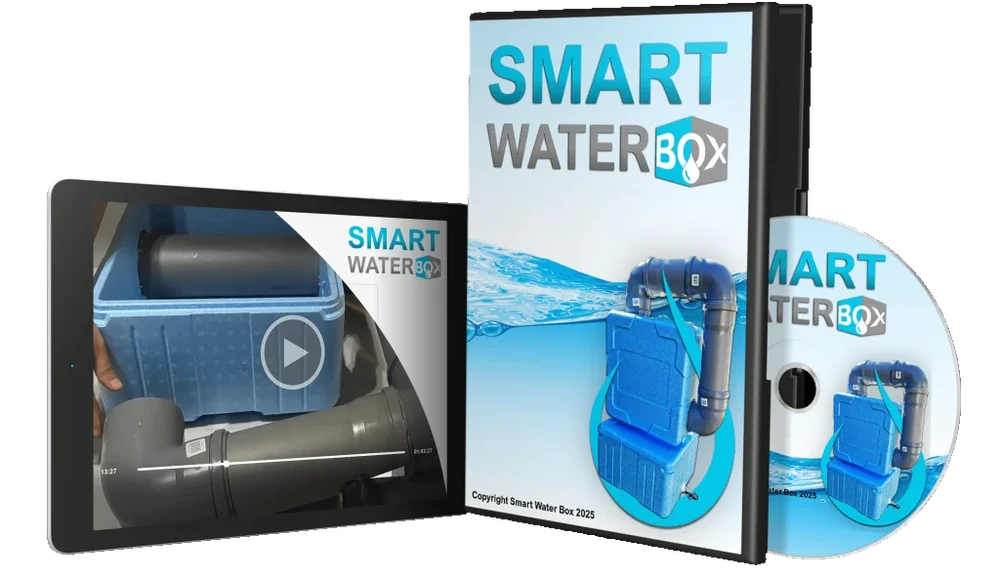
What the digital guide includes
The seller describes three parts: a written build guide with diagrams, video walkthroughs that show the assembly on screen, and two free bonus guides (a solar water heating blueprint called SunHeat DIY and a general project guide called Home DIY Secrets). The cover artwork shows a blue insulated box connected to grey pipe, which suggests the kind of parts involved, but the exact parts list, dimensions and any electrical components are inside the paid material and we have not reviewed them.
Bonus contents and the offer can change, so treat this list as a description of the offer when this page was last reviewed rather than a promise.
How the proposed DIY concept is intended to work
The seller's pitch is that a modest condensation unit built from ordinary materials can collect water from ambient air. In broad terms a build like this has four jobs: bring moist air in, give that air a surface that is colder than its dew point, let the droplets run into a container, and keep the collected water clean. The seller's guide is meant to show how those jobs are arranged. Whether the particular arrangement works well in your climate has not been independently verified.
Atmospheric water collection explained
Dew point is the key idea
Air holds water vapor. The National Weather Service defines the dew point as the temperature to which air must be cooled, at constant pressure, to reach 100% relative humidity. Cool air below that temperature and vapor condenses. The cold outside of a drinks glass on a humid day is the everyday example. Anything that collects water from air by condensation depends on getting a surface below the dew point, and on how much moisture the air carries.
Other approaches exist
Fog nets, dew collectors, refrigeration-based machines and sorbent materials all harvest atmospheric water in different ways. Laboratory research, including a 2017 Science paper on a metal-organic framework that collected water at humidity as low as about 20%, shows the idea is physically sound. That research used specialised materials in a controlled setting and does not tell us anything about a hardware-store build.
Why output is limited
The water you can collect is capped by the vapor in the air flowing through the unit, by how well the surface stays cold, and by how long the unit runs. A passive box in a dry or cold place may yield very little. Anyone claiming a fixed number of liters per day without stating humidity, temperature and energy input is not giving you a usable figure, and we publish none for this guide.
Components and materials to verify before buying
Because the parts are not supplied, the useful question is whether you can see the full materials list before you pay. Ask the seller, or check the checkout page, for answers to these:
- Is there a complete parts list with sizes, and are the parts easy to buy where you live?
- Does the design need any electrical components, cooling device or fan, and if so what power and safety precautions apply?
- Which materials touch the collected water, and are they rated for drinking-water contact?
- What tools are needed (cutting, drilling, sealing) and are you comfortable using them?
- Does the guide address cleaning and maintenance to limit microbial growth?
What the guide does and does not guarantee
| Topic | What is stated | Status |
|---|---|---|
| Format | Digital guide with video; nothing shipped | Seller description |
| Price | $39.69 one-time | Seen at checkout Oct 13, 2026 (owner-confirmed); can change |
| Money-back guarantee | 60 days via the seller and ClickBank | Seller-stated; confirm on your receipt |
| Water output | No figure promised on this site | Not independently verified |
| Drinking-water safety | Not claimed; treat and test | No certification known |
| Independent lab test | None found | Unverified |
Practical considerations before starting
Plan your spot: placement affects airflow and temperature. Humidity and temperature move through the day and across seasons, so judge the unit over days, keep notes and compare conditions. Check leaks, because lost water is lost yield. Think about where the collected water will be stored and used, since stagnant water is where problems start.
Water quality and safety
Water safety notice
Never assume water from a home-built collector is safe to drink. It can pick up microbes, dust and chemicals from collection surfaces, construction materials, the surrounding air and storage containers. Smart Water Box is not a certified purifier. Use collected water for non-drinking purposes unless it has been treated and tested to a standard you trust, and keep stored drinking water for emergencies.
The EPA and CDC both describe boiling or chemical disinfection as ways to deal with microbes in emergency water, and the EPA points out that these methods do not remove heavy metals, salts or most chemicals. That is why material choice and testing matter for any DIY collector: treatment fixes some risks and not others. A certified purifier or a laboratory test is the way to know what is actually in your water.
Potential costs beyond the guide price
- Parts: pipes, fittings, a container and sealants. We cannot quote a total because the parts list is not published here.
- Tools you may not own.
- Filtration, disinfection supplies and water testing if you intend to drink the water.
- Electricity, if your design uses any powered component.
- Time for assembly, troubleshooting and cleaning.
Who may find the guide useful
People who enjoy hands-on projects, want to understand condensation and water-from-air by building a small unit, and are happy to treat the output as a learning project or a source of non-drinking water. Gardeners and hobbyists in humid climates are the most obvious audience, though nothing here has been tested to confirm results.
Who should investigate alternatives
If you need a reliable water supply, a plug-and-play appliance, or drinking water you can trust without extra testing, a certified commercial unit, a filtered municipal supply, stored water or a licensed well and treatment service are more dependable options. A DIY guide is not a replacement for emergency water storage.
Keep reading
For a balanced assessment, see the independent Smart Water Box review. To understand who sells the guide and how to check the checkout page, see official-site and seller information. If you are ready to compare terms, the buying information page sets out what to confirm before ordering.
Check the current offer on the seller's checkout pageOpens ClickBank checkout in a new tab. Affiliate link. Confirm price and terms before paying.
Frequently asked questions
What is Smart Water Box?
Smart Water Box is a digital DIY guide with video walkthroughs that, according to the seller, shows how to build a small atmospheric water collection unit at home. It is a download, not a finished appliance.
Is Smart Water Box a physical product?
No. According to the seller's description it is delivered digitally and nothing is shipped. The parts for the build are sourced separately by the buyer.
Does the guide include physical equipment?
No physical equipment is described as included. Pipes, containers, fittings and tools are bought separately, so total project cost will exceed the guide price.
Can atmospheric water collection work in every climate?
No. The amount of water in the air limits how much can be collected, so dry or cold conditions generally give much less water than warm, humid ones. No output figure for this guide has been independently verified.
Does water collection require electricity?
It depends on the design. Passive condensation relies on a surface cooler than the air's dew point, while refrigeration-based and sorbent-based machines use energy. What power, if any, the Smart Water Box design needs is not independently verified here; check the seller's materials.
Is water collected from a DIY system automatically safe to drink?
No. Collected water can contain microbes and chemicals from surfaces, materials, air and storage. Treat and test it before drinking, or use it only for non-drinking purposes.
Is Smart Water Box independently tested?
We have found no independent laboratory test of the guide or of builds made from it. Absence of a test is not proof it does not work; it means output and water quality are unverified.
How this page was written
Product details come from the seller-supplied description already used on this website. No one involved in this site has built the system, measured its water output or tested the water, and we have not received or reviewed the full paid guide. The price and the 60-day guarantee are the seller-listed terms as published on this site and have not been independently confirmed at checkout. General technical and water-safety statements are checked against the public sources listed on this page. Last reviewed October 13, 2026.
Sources for general technical and safety statements
These sources support general statements about dew point, atmospheric water harvesting research and water treatment. None of them tests or mentions Smart Water Box.
- National Weather Service (NOAA), La Crosse, WI, “Dew Point vs Humidity” — weather.gov/arx/why_dewpoint_vs_humidity. Defines dew point as the temperature to which air must be cooled, at constant pressure, to reach 100% relative humidity.
- Kim, H., Yang, S., Rao, S. R., Narayanan, S., Kapustin, E. A., Furukawa, H., Umans, A. S., Yaghi, O. M., Wang, E. N., “Water harvesting from air with metal-organic frameworks powered by natural sunlight,” Science, 13 April 2017, DOI 10.1126/science.aam8743. A laboratory-scale study of a specialised sorbent material; it shows that harvesting water from air is physically possible, including at low humidity, and says nothing about condensation-box builds.
- U.S. Environmental Protection Agency, “Emergency Disinfection of Drinking Water” — epa.gov. Boiling or disinfection kills most microorganisms but does not remove heavy metals, salts or most chemicals; cloudy water should be filtered first.
- U.S. Centers for Disease Control and Prevention, “How to Make Water Safe in an Emergency” (page dated 19 September 2024) — cdc.gov. Describes boiling and chemical disinfection for emergency water.
- World Health Organization, Guidelines for drinking-water quality, 4th edition incorporating the 1st addendum (24 April 2017) — who.int. The international reference for drinking-water quality targets.
Affiliate disclosure: this is an independent website, not the seller's official site. If you buy through our order links we may earn a commission at no extra cost to you. Read the full disclosure.